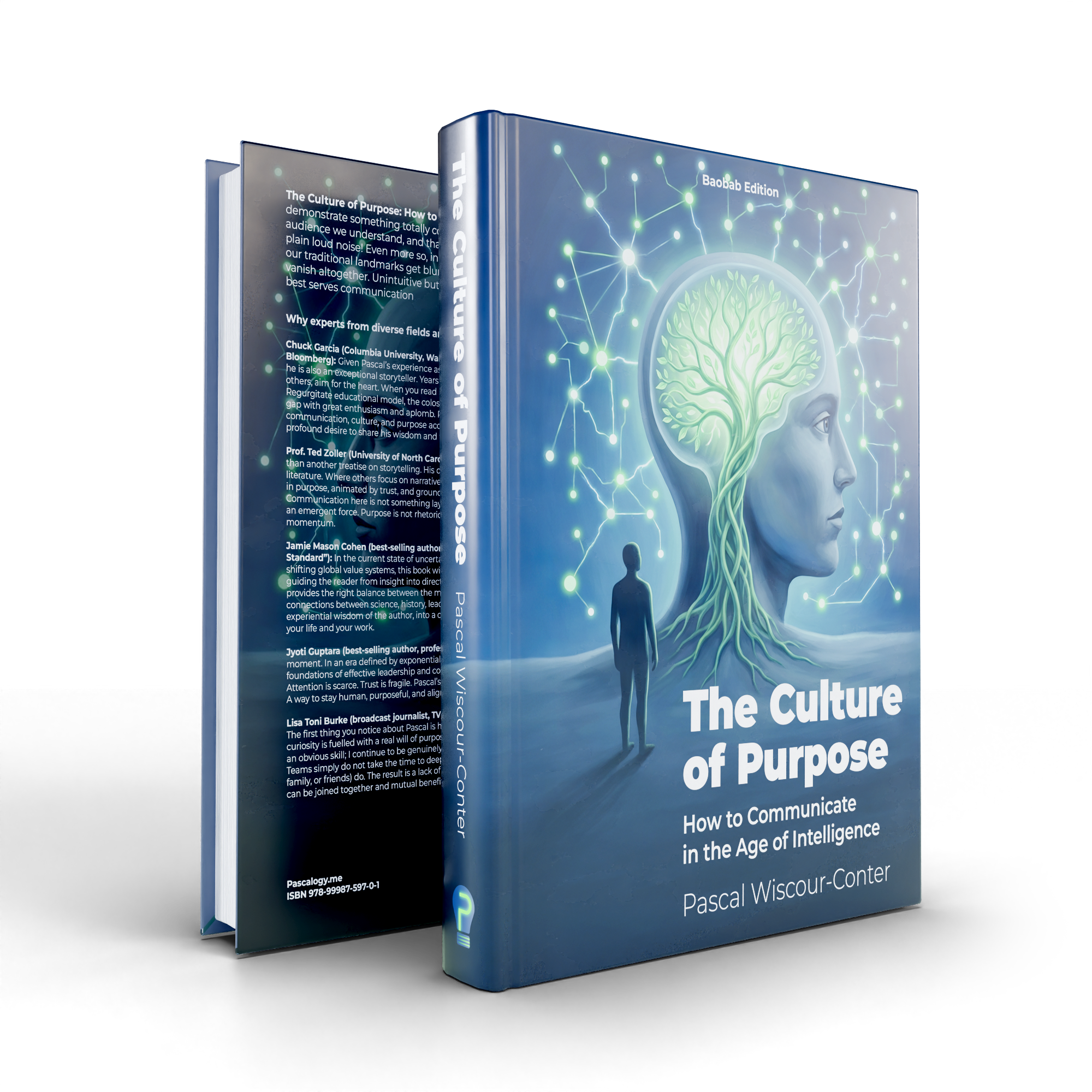
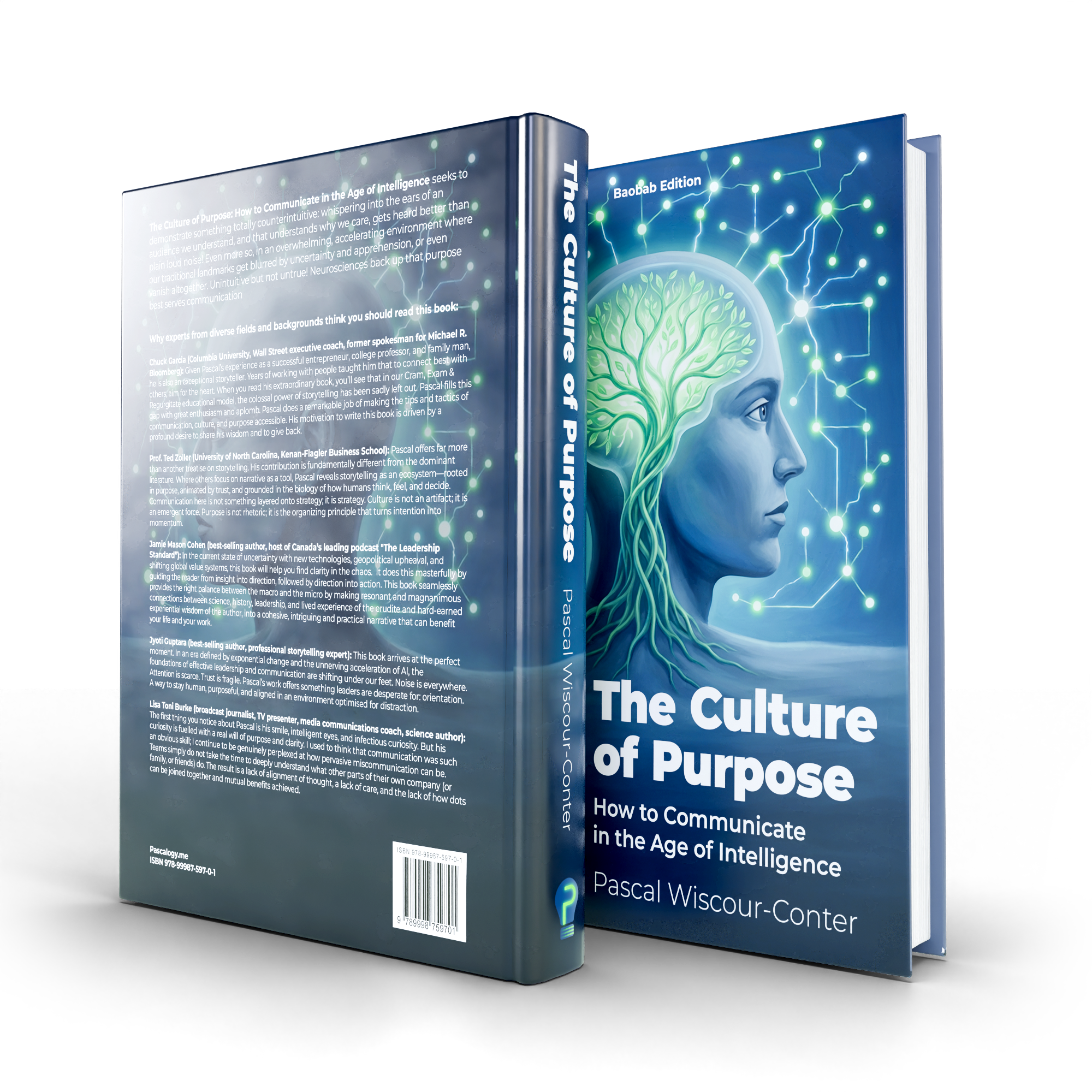
The Culture of Purpose
The Culture of Purpose: How to Communicate in the Age of Intelligence seeks to demonstrate something totally counterintuitive: whispering into the ears of an audience we understand, and that understands why we care, gets heard better than plain loud noise! Even more so, in an overwhelming, accelerating environment where our traditional landmarks get blurred by uncertainty and apprehension, or even vanish altogether. Unintuitive but not untrue! Neurosciences back up that purpose best serves communication.
The Culture of Purpose or How to Communicate in the Age of Intelligence is the result of Pascal’s lifelong endeavor as an entrepreneur, strategist, business developer, and storyteller. Someone who convinced millionaires to register and operate megayachts in a landlocked country, who was a “Cloud” early adopter, seeking to evangelize other professionals before SaaS platforms were a thing, who got involved in screenwriting for the movie industry and Broadway, who learned how to ally purpose and storytelling to connect and engage people.
As Pascal went from multi-entrepreneur to academia and teaching, this book is the result of a 3-year project, based on personal experience and broadly assembled research, which will help if you ultimately seek to understand…in very practical ways:
• How alignment between vision, mission, and value proposition can generate a sense of authenticity, and how such perceived authenticity generates trust, which helps engage meaningfully with audiences?
• How you can make that alignment sustainable by rooting it into purpose, and steady by applying a proven storytelling methodology, allowing you to inspire and influence people profoundly and durably?
• How such a purpose-anchored philosophy could offer some guidance in an exponential environment where technology increasingly went from sobering to chilling to terrifying, for some?
Learn how to share your Intentions through skillfully crafted Narratives of Messages containing a Meaning that makes Sense for multiple Audiences, converting the Inspiration generated by your Seed Idea into Action.
Storyline
This book is not about giving any lessons in communication, strategy, or leadership. It is a byproduct of Pascal’s own need to understand, and once he did, his urge to convince others of the profound things he was fortunate enough to get exposed to.
When trying to persuade entrepreneurs and business leaders of the importance of real storytelling and why it needs to be grounded in purpose, he would, time and again, get confronted with misunderstanding, often disbelief, occasionally some contempt. What started with a white paper led to an MBA class, which represents the original plan of this book. For his students, Pascal wanted to regroup in one place and storytell all the things I felt they would need and could use to find their way and blossom in an exponential environment.
In Part One, we briefly dive into human history to understand the origins of communication, and then attempt to look into the future to get a better appreciation of where communication — and the role of communication in business — might be headed.
In Part Two, we lean on biochemistry and neuroscience, which have greatly contributed in the first decades of the 21st Century in understanding how human exchanges work, to better appreciate what happens in our mind and body.
In storytellers’ language, Part One is setting the stage and slowly building up the plot, while Part Two provides essential information to put into perspective what screenwriters call a dramatic framework.
Part Three is dedicated to observing how these elements play out in an organizational context, from understanding what sets great leaders and business developers apart in their communication to how great storytelling drives better people engagement and business development. We explore how trust represents a cornerstone of communication, served by various tools to stand out in a noisy, crowded marketplace. We make up a Strategic Communication Equation™, observing how storytelling rests upon understanding how to awaken the senses, catch attention, and trigger releases of neurotransmitters that will shackle the brain… literally.
Part Three is when the underlying dramatic irony becomes apparent as we near the anti-climax.
Part Four introduces a practical application of a powerful professional storytelling methodology, helping us to craft an engaging leadership talk and compelling sales pitches for clients and investors, amongst others. Understanding a market, identifying its actors, spotting their problems, and learning to discuss them in their language. Translating a great story-to-be-told into a well-narrated, actual story. Avoiding cognitive biases and other common pitfalls that lure us into the dark side of self-congratulatory noise.
Part Four is when exploring concrete applications has us experience the comic relief, which becomes increasingly apparent as we rush towards the climax and the resolution of this journey.

And all along the way, we can experience or witness the use of storytelling as an integral ingredient of how all these elements are being laid out and illustrated. Some will be obvious ones, some less so, and some on the more cheeky side.
While most elements of this book are not new concepts, even though some were revolutionary ideas when they were first introduced, Pascal have brought them together in ways that help him convey his vision and drive a message he believes to be crucial. Occasionally, not shying away from combining them in unsettling ways and giving them unorthodox names, or making up weird equations. Sometimes, the outcome may incidentally end up being a new take or a surprising way of looking at established things, perhaps leading to a new concept, after all. Probably no dramatic breakthrough ideas… but rather unhinged combinations and new ways of framing existing concepts into new ideas, terms, labels, or visualizations. Or maybe yes…
Either way, it was all imagined, planned, and executed with the supreme intention of connecting the dots to drive a cause believed to be common. And one of the key outcomes is the Tree of (Business) Life™.
Why experts from diverse fields and backgrounds think you should read this book:
Chuck Garcia (Columbia University, Wall Street executive coach, former spokesman for Michael R. Bloomberg): Given Pascal’s experience as a successful entrepreneur, college professor, and family man, he is also an exceptional storyteller. Years of working with people taught him that to connect best with others, aim for the heart. When you read his extraordinary book, you’ll see that in our Cram, Exam & Regurgitate educational model, the colossal power of storytelling has been sadly left out. Pascal fills this gap with great enthusiasm and aplomb. Pascal does a remarkable job of making the tips and tactics of communication, culture, and purpose accessible. His motivation to write this book is driven by a profound desire to share his wisdom and to give back.
Prof. Ted Zoller (University of North Carolina, Kenan-Flagler Business School): Pascal offers far more than another treatise on storytelling. His contribution is fundamentally different from the dominant literature. Where others focus on narrative as a tool, Pascal reveals storytelling as an ecosystem—rooted in purpose, animated by trust, and grounded in the biology of how humans think, feel, and decide. Communication here is not something layered onto strategy; it is strategy. Culture is not an artifact; it is an emergent force. Purpose is not rhetoric; it is the organizing principle that turns intention into momentum.
Jamie Mason Cohen (best-selling author, host of Canada’s leading podcast “The Leadership Standard”): In the current state ofuncertainty with new technologies, geopolitical upheaval, and shiftingglobal value systems, this book will help you find clarity in the chaos. It does this masterfully by guiding the reader from insight into direction,followed by direction into action. This book seamlessly provides the right balance between the macro and the micro by making resonant and magnanimous connections between science, history, leadership, and lived experience of the erudite and hard-earned experiential wisdom of the author, into a cohesive, intriguing and practical narrative that can benefit your life and your work.
Jyoti Guptara (best-selling author, professional storytelling expert): This book arrives at the perfect moment. In an era defined by exponential change and the unnerving acceleration of AI, the foundations of effective leadership and communication are shifting under our feet. Noise is everywhere. Attention is scarce. Trust is fragile. Pascal’s work offers something leaders are desperate for: orientation. A way to stay human, purposeful, and aligned in an environment optimized for distraction.
Lisa Toni Burke (broadcast journalist, TV presenter, media communications coach, science author): The first thing you notice about Pascal is his smile, intelligent eyes, and infectious curiosity. But his curiosity is fuelled with a real will of purpose and clarity. I used to think that communication was such an obvious skill; I continue to be genuinely perplexed at how pervasive miscommunication can be. Teams simply do not take the time to deeply understand what other parts of their own company (or family, or friends) do. The result is a lack of alignment of thought, a lack of care, and the lack of how dots can be joined together and mutual benefits achieved.
Official Launch on May 4th, 2026
Available on:
Paperback available on July 31st, 2026
Wider Release on all platforms on October 15th, 2026